Set a fair comparison boundary
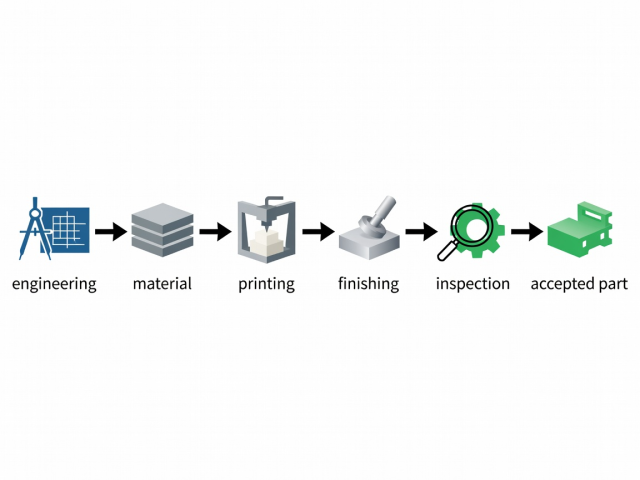
Begin with a common drawing, material condition, inspection scope and delivery requirement. A printed near-net-shape blank should not be compared directly with a fully machined and inspected conventional part. Include the operations needed to reach the same accepted condition, and distinguish recurring production costs from one-time engineering, fixtures and qualification work.
Additive manufacturing may reduce assembly or enable useful internal geometry, but these benefits must be connected to a real requirement. If part consolidation removes joints, consider inspection, repair and replacement consequences as well as assembly savings. A more complex single component can be valuable, yet it can also concentrate production and service risk in one expensive item.
Build the cost model around operations
A practical model includes design preparation, build setup, feedstock consumption, machine occupancy, labour, thermal processing, support removal, machining, inspection and logistics. Machine occupancy is broader than laser-on or deposition time: loading, cooling, unloading and changeovers can constrain availability. Keep assumptions visible so that buyers can distinguish a measured input from a planning estimate.
Allocation matters. A machine-hour rate may include capital recovery, maintenance and facility overhead, or it may exclude some of those costs. Avoid counting an item twice, and do not compare rates with different boundaries. Labour should reflect attended tasks rather than an assumption that every hour of a long build requires a dedicated operator.
A transparent example—not a market quotation
The following arithmetic example is created for this guide. Its inputs are hypothetical, not supplier prices or reported industry averages. It illustrates the whole-route cost logic discussed in NIST’s Costs and Cost Effectiveness of Additive Manufacturing, Special Publication 1176. That publication is a methodological reference, not the source of these example figures.
| Included cost | Example batch amount |
|---|---|
| Preparation and setup | £600 |
| Feedstock consumed and allocated losses | £900 |
| Machine occupancy | £1,800 |
| Thermal treatment and finishing | £1,200 |
| Inspection | £500 |
| Total included batch cost | £5,000 |
Dividing £5,000 by 18 accepted parts gives approximately £277.78 per accepted part. Dividing by all 20 started parts would give £250 and hide the effect of rejection. This simplified example excludes tax, shipping, initial design development and qualification. It also assumes the listed batch costs have already captured the work performed on rejected items.
If only 16 parts were accepted at the same batch cost, the result would be £312.50 per accepted part. In a real route, rejection might also change inspection, rework and replacement costs, so holding total cost constant is only a sensitivity check. The purpose is to expose assumptions, not forecast a quotation from a small table.
Find the constraint outside the printer
Printing capacity is useful only when downstream operations can absorb its output. A shared heat-treatment furnace, a specialist machining fixture or a limited inspection slot may control delivery. Map the queues between operations and identify which resource limits accepted output. Purchasing another printer can increase work in progress without improving delivery if the actual bottleneck remains untouched.
Batch packing also creates trade-offs. Adding parts may improve machine utilisation while increasing build duration, identification effort or the consequence of a failed build. Evaluate the complete schedule, including cooling, material recovery and changeover. For large-format parts, crane access, transport and metrology capacity can be as important as deposition productivity.
Compare alternatives with honest uncertainty
Request a comparable route for machining, casting, forging or fabrication where appropriate. Conventional tooling may be expensive initially but economical at stable volume. Additive can be attractive when geometry, customisation or avoided assembly delivers a specific benefit. Neither route wins automatically because an annual quantity sits above or below a universal threshold.
Use ranges for uncertain yield, finishing time and utilisation. Ask suppliers which assumptions have been demonstrated and which require a pilot run. A sensible scale-up decision often begins with a representative part and a measured end-to-end trial. The most valuable result may be discovering a process constraint early enough to change the design.